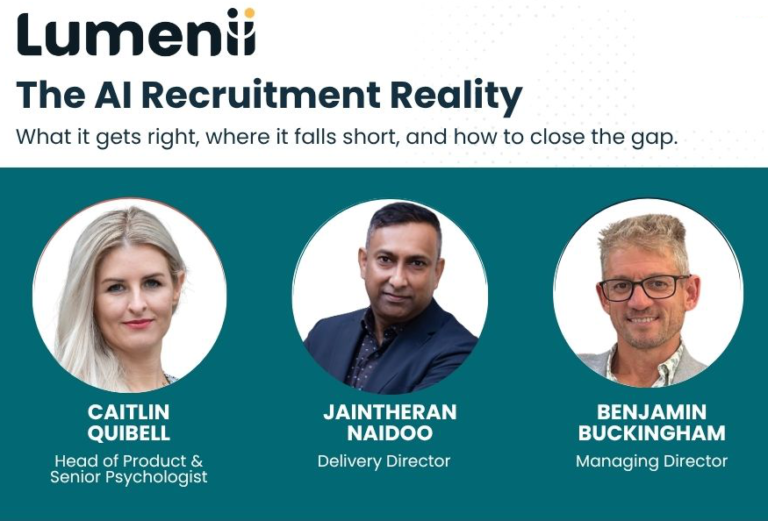

A candidate who has spent fifteen years mastering their craft can submit a CV that looks, to a screening algorithm, exactly like one built this morning by an AI CV optimiser. Neither document tells you which candidate is which. That’s the problem HR teams are grappling with right now, and it’s what Lumenii sat down to unpack with CHRO South Africa at our recent webinar on the AI Recruitment Reality.
The Q&A session ran long, so here are the ones we didn’t get to, answered by Caitlin Quibell, Lumenii’s Head of Product and Senior Psychologist.
Table of Contents for AI Recruitment Reality Webinar
- AI Governance And Disclosure
- Adverts, CVs And The Keyword Problem
- What AI Shouldn’t Be Trusted To Do Alone
AI Governance And Disclosure
Q: What controls should be in place before rolling out AI in the recruitment process?
There’s a minimum set you need before you switch anything on. Write a policy that spells out what the tool is allowed to do and what it isn’t. Agree your criteria and scoring rubrics upfront, not once candidates are already coming through the pipeline. And make sure someone specific is named as the human decision-maker at the point of rejection, so that call always sits with a person, not the tool.
You’ll also want a proper POPIA review done before go-live. That means looking at cross-border data transfer, the operator’s contract terms, and how you’re getting candidate consent. Capture your baseline metrics before launch too, otherwise you’ll have no way of knowing if the tool actually made things better. And train your managers on all of it, not just the recruitment team.
Here’s a good gut check: if you couldn’t sit down six months from now and explain exactly why the tool made the call it did, you’re not ready to deploy it.
Q: How do you configure tools like Claude, ChatGPT, Perplexity or Gemini to operate within clear boundaries? What does that look like in practice?
It comes down to how tightly you set up the prompt. Give the AI a defined role, and be explicit about what it should never do. Don’t leave the evaluation criteria or scoring rubric up to the model’s own judgement, put it in the prompt yourself. Ask it to show its working too: it should cite the specific evidence behind every score, and flag when it isn’t confident rather than quietly filling the gap with a guess.
Lock down the output format so every result comes back structured the same way, and build in a step where a human has to sign off before anything moves forward. That’s the prompt side sorted. On the platform side, use enterprise tiers, switch off model training on your data, and actually read the data-processing terms before you commit.
Q: What does good AI governance practice actually look like in recruitment?
It starts with a written policy that names what AI may and may not be used for, no ambiguity. Then a defined human decision point, with an actual named person accountable for it. Document your criteria and rubrics properly, so if anyone asks you to justify a decision months down the line, you can. Keep records.
Here’s the thing though: the biggest governance gap we see isn’t in the ATS at all. It’s shadow use, managers quietly running candidate details through consumer AI tools outside any system or policy, with no record of what went in or what came out.
Q: Should candidates be told upfront that a company uses AI in its recruitment process?
Yes, and honestly, this is becoming non-negotiable rather than optional. Think about it from the candidate’s side first: they have a right to understand a process that’s deciding something this important about their life. That’s the ethical case on its own.
Then there’s where regulation is heading. The EU already requires this kind of disclosure, and POPIA gives candidates rights around automated decisions made about them, so this isn’t a future problem, it’s a current one.
And there’s a case that’s purely in your own interest too. Telling candidates upfront means they engage with your process honestly, and it protects you if a decision ever gets challenged down the line.
Adverts, CVs And The Keyword Problem
Q: Do we continue sharing detailed job descriptions, which candidates then mirror in their CVs, or should we stick to basic outlines when advertising vacancies?
My opinion would be to keep the detail in. Vague adverts could attract vague applications and disadvantage genuinely strong candidates who could self-select out when they can’t tell what the role needs. A clear job description is also a fairness and defensibility asset if a decision is ever challenged. The problem isn’t that candidates mirror your JD; it’s relying on the CV as the deciding evidence.
Q: What happens when a candidate looks qualified simply because they’ve packed their CV with the right keywords, while the best fit talent doesn’t rank high in the algorithm? How do you make sure every candidate still gets a fair shot?
This is the central weakness of CV-based ranking: keyword matching measures CV-writing skill rather than capability. 3 Practical moves: don’t use keyword matching as an elimination gate, only as a sort; set minimum criteria rather than ranking against each other; and introduce validated assessments early. For example, in Lumenii’s AI-recruit solution, we run CV screening and assessments at the same time. Also make sure you audit who your filter is actually screening out.
Q: During the pre-screening process, are AI tools able to distinguish between the high-potential candidates and those who optimise their CV’s using AI.
No, not reliably. A high-potential candidate and a skilled CV-optimiser both produce a well-matched CV, so the document can’t separate them. Also, a CV-optimiser and a high-potential candidate might be one and the same. What screening can legitimately do is confirm minimum criteria. Distinguishing potential requires either measurement through validated assessments or structured interviews.
Q: Do recruiters look down on AI generated CVs?
Some do, but most recruiters now assume some AI involvement, and it’s rapidly becoming unremarkable. What lands badly isn’t AI assistance, it’s genericness: a CV that reads as templated and clearly hasn’t been tailored to the role. Using AI to structure and sharpen your own genuine experience is entirely reasonable. Where it costs you is if it invents things, or produces a version of you that you can’t speak to convincingly in an interview.
Q: Do ATS software reject CVs with colour, graphics and tables in their layout? Is this true, and what should I do instead?
Broadly true, yes. Heavy graphics, multiple columns, text inside images, tables and unusual fonts can all parse badly, scrambling your experience or dropping it entirely. That said, as AI models get smarter, this risk is becoming smaller, and a well-designed prompt will generally flag where CVs are getting kicked out due to technical glitches so a human can intervene. A well-designed prompt will also generally extract CVs into a standard file format, e.g. markdown, before proceeding, which allows a human to review the summarised output and align it to the original CV and screening outcomes.
In the meantime, here’s a practical workaround: submit a clean, single-column, text-based CV with standard headings for the system, and link prominently to your portfolio for the design work. You lose nothing, because the portfolio is where a human will actually assess your designs.
What AI Shouldn’t Be Trusted To Do Alone
Q: Could relying too heavily on AI cause organisations to overlook the importance of independent background screening?
Yes, and it’s a real risk precisely because AI output feels comprehensive. Verification of qualifications, employment history, credit and criminal record is a separate, factual check that no language model performs, and can’t perform. If anything the polished-application problem makes independent background screening more important rather than less, because the surface is now easier to optimise than it used to be.
Q: There’s always a behavioural component to what makes a candidate suitably qualified. As AI plays a bigger role, are we at risk of losing the culture and values component of recruitment? How do we avoid that?
We shouldn’t let it go, and we don’t need to. Behaviour and values are exactly what structured behavioural interviewing and psychometric assessments measure. And we know that research shows they’re the best-evidenced part of the process. The real risk isn’t AI removing the behavioural component; it’s organisations skipping it because the earlier AI-assisted stages felt thorough enough. The safeguard is simply to keep it as a required, non-negotiable stage rather than an optional extra.
Q: What metrics should HR monitor to determine whether AI recruitment is actually improving hiring outcomes?
Weight outcomes over process. On quality: performance ratings at six and twelve months, probation pass rate, early attrition, hiring-manager satisfaction. On fairness: pass-through rates by group at every stage, so you can see adverse impact developing. On efficiency: time-to-hire, cost-per-hire, recruiter hours saved. Plus candidate experience and offer-acceptance.
Q: Could you recommend a secure, reliable tool for screening large volumes of CVs and applications, one that filters candidates against predefined criteria and generates a shortlist with key candidate information?
Our recruitment platform does exactly this. In short, it screens CVs and screening questionnaire responses using AI against criteria you define up front, with the evidence behind each score visible rather than hidden in a black box. It also brings psychometric assessment into the same view, so candidates aren’t ranked on their CV alone, and it produces a ranked shortlist with the key information exportable.
To learn more, click here.
Thanks to everyone who joined the session and sent through questions. If yours didn’t make the cut, or a new one comes to mind, get in touch and we’ll follow up directly.