
AI didn’t create the biggest risk in recruitment. It made everyone equally confident and equally unverifiable.
Half the hiring teams on our recent AI in recruitment webinar, co-hosted with CHRO South Africa, told us live that they’re only “experimenting” with AI in their process, testing it on specific, non-critical tasks, nothing more.
Another quarter said they’re using it across the board. Eleven percent haven’t touched it at all. Seventeen percent are still cautious.
That split is the real story of AI in South African recruitment right now. It isn’t a debate about whether to adopt the technology. Adoption already happened. What hasn’t happened, for most organisations in that room, is a plan for what to do once both sides of the hiring desk are running the same tool.
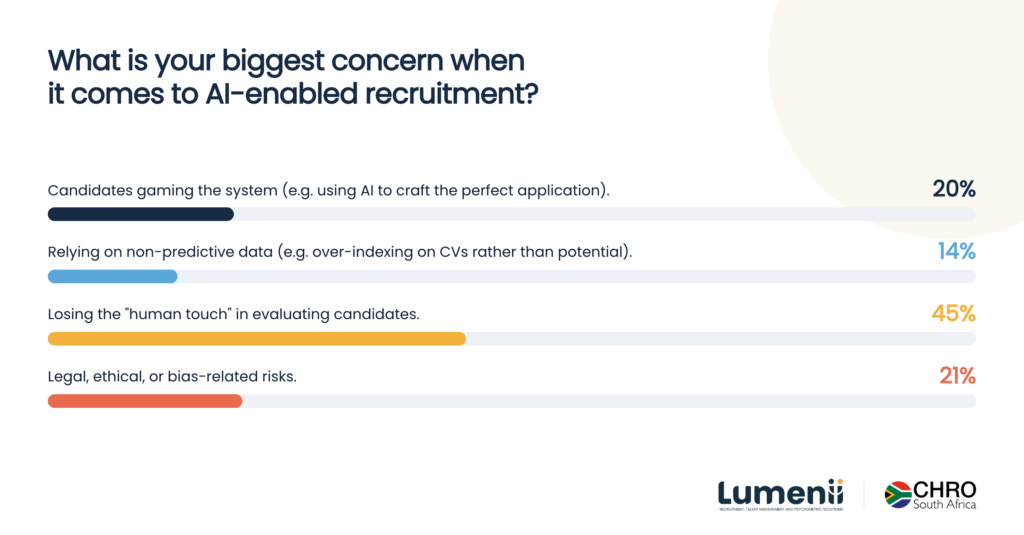
Because here’s what actually worried that audience most, and it wasn’t what the industry commentary usually assumes. When we asked hiring teams what concerns them most about AI in their process, candidates gaming the system didn’t come close to the top.
Losing the human element in the decision did, by a clear margin. That’s the tell. The room wasn’t worried about being tricked. It was worried about not being able to explain, defend, or stand behind a decision anymore, which is a far more dangerous gap, because it’s invisible until someone challenges it.
A polished CV and a coached answer are the same document
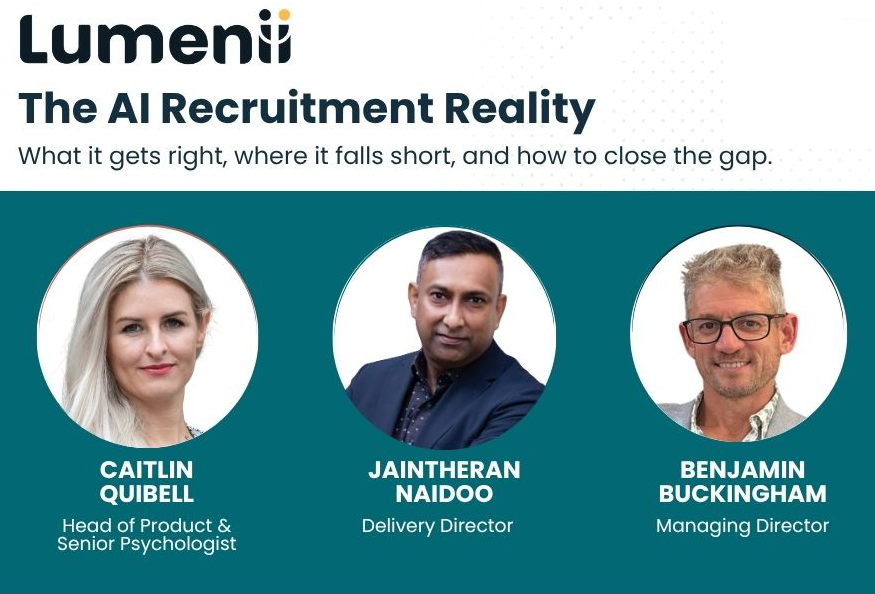
Caitlin Quibell, our Head of Product, opened the session with an analogy that framed everything after it: AI works like a mirror. It reflects back whatever you feed it, and it can’t see what’s behind that reflection or beneath the surface of the page in front of it.
That’s true whether the person holding the mirror is a recruiter running a CV through a screening prompt, or a candidate running that same CV through a rewrite tool before submitting it.
Neither a polished CV nor a well-rehearsed, AI-sharpened interview answer has ever been proof of anything. Both are self-report, the version of events the candidate wants believed. AI didn’t invent that gap between self-report and reality. It made both sides of it faster to produce and harder to tell apart, which connects directly to the risk Caitlin flagged about how the technology behaves: ask an AI model the same question twice, she said, and you can get two different answers. Fine for drafting an email. Untenable when you have to stand behind a hiring decision months later.
That’s why the adoption numbers matter more than they look. A quarter of organisations using AI across their entire process, and half only experimenting in pockets, means most hiring teams have solved the speed problem without solving the trust problem. They’ve made filtering faster. Almost nobody in that room had rebuilt verification to match.
Why a better filter isn’t the fix
The instinct when candidates start using AI to get past a process is to build a better gatekeeper on the other side. A detection tool, a fresh screening layer. That’s the wrong fight. It’s an arms race where whichever side updates last, loses.
Jaintheran Naidoo, our Delivery Director, made the sharper case during the session: the fix isn’t detecting AI use, it’s making it structurally irrelevant. An AI tool can help someone prepare a strong first answer to a competency-based interview question. It’s far less useful for the second or third follow-up probe that asks who made the actual call, what changed the next time the same situation came up, or where it went wrong.
“Typically an individual that uses AI to prepare might get past your first STAR probe,” he said, “but if you ask a second and a third one, it’s less likely that AI is going to prepare you for that.”
STAR -Situation, Task, Action, Result is the standard behavioural interview format most hiring managers already use. Rehearsed answers survive one layer. They rarely survive three.
When asked what’s most critical to balancing AI efficiency with hiring quality, the vote came back almost evenly split between competency-based interviewing, deep human review, and clearer AI policy with candidate transparency.
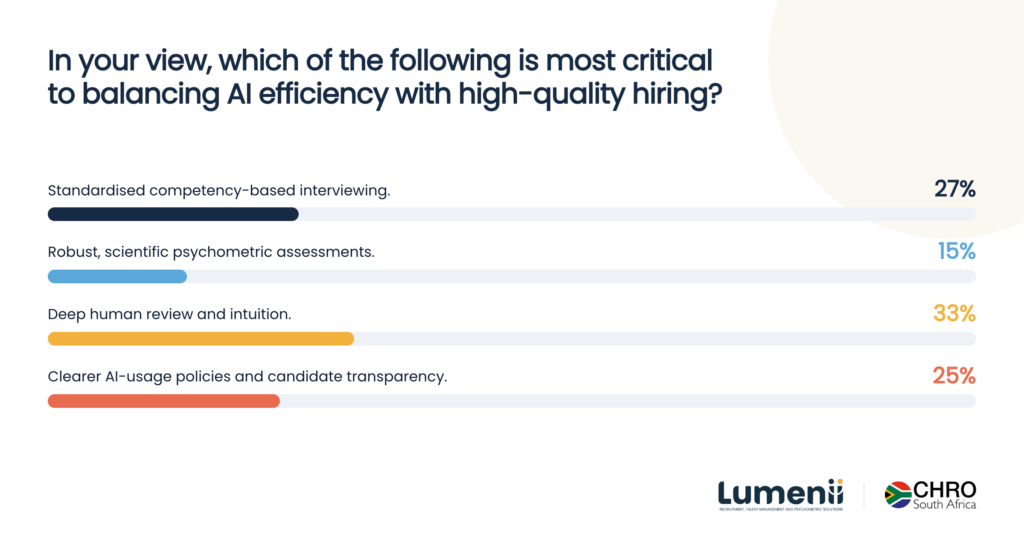
No single answer dominated and that’s not indecision, it’s an accurate read of the problem. None of those three things works in isolation. Every answer the panel gave during the session’s Q&A circled back to combining them, never picking one over the others.
Benjamin Buckingham, our MD, put it most directly when the conversation turned to whether AI tools alone could justify their own investment case, or whether they should replace verified psychometric assessment: “It’s not an or question, it’s an and question. What we would never do is have a bot make a decision, or even a recommendation, based on information that’s only surface level.”
The same logic held when the discussion moved to building recruitment bots aligned to specific hiring criteria; the value, Benjamin argued, is in converting unstructured information into structured information and feeding a process with multiple steps, never in letting the bot stand in as the decision itself.
The one thing a structured process still can’t reach
Even a well-run structured interview has a ceiling: it only tells you about a role someone has already done. That’s where psychometric assessment does something genuinely different, because it isn’t asking anyone to describe themselves at all. It measures how a person’s underlying capability lines up against a role they haven’t done yet; a different question entirely, and one no amount of CV polish can answer for them.
None of this is theoretical for regulators. South African law already prevents rejecting a candidate on the basis of automated processing alone, which means a human has to be meaningfully involved at every decision point.
Where the recruiter’s role is actually heading
Asked how they expect the recruiter’s role to change over the next two years, only two percent of the room said they were unsure. Almost everyone else had a firm view, and the largest share pointed toward process management, human connection, and complex decision-making, not full automation. That’s a room that has already made up its mind about where this goes, even if most organisations in it haven’t yet built the process to get there.
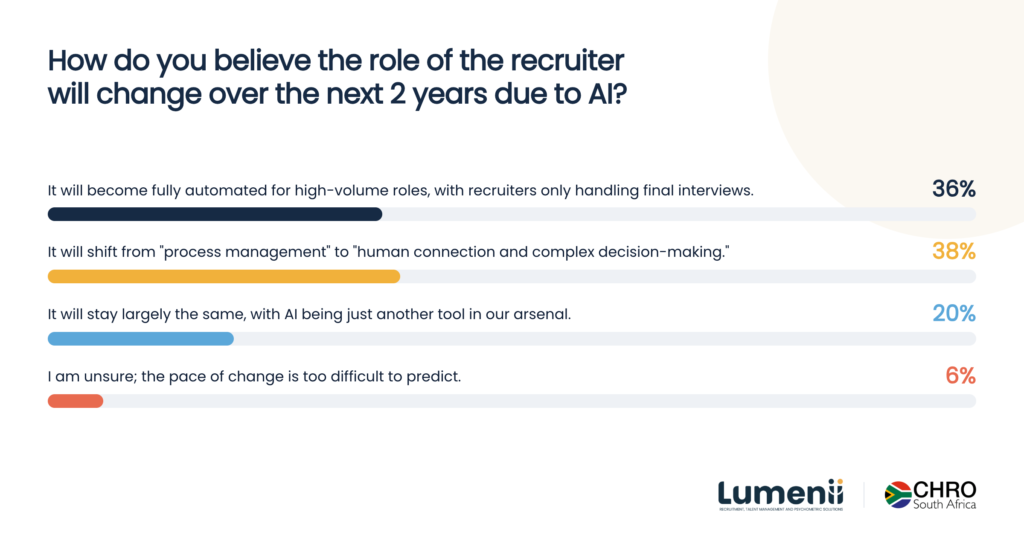
Caitlin’s read matched it exactly: “A recruiter’s time is really going to be spent doing things like reviewing psychometric results and doing very good structured interviews. The role might become a lot more technical.”
Benjamin closed the session with the line that ties the whole argument together. “The machine will never replace the human, and it’s absolutely critical that humans continue to lead the decision.”