
Lumenii brought South Africa’s succession planning problem to HR Summit 2026 and it packed the room all day.
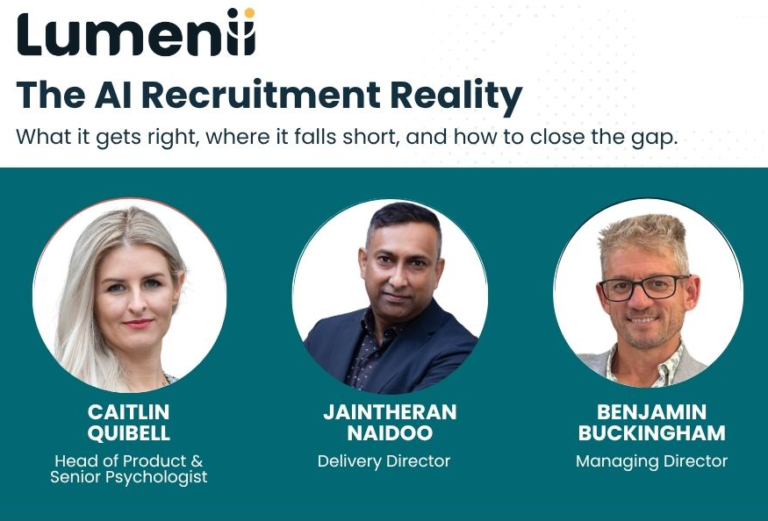
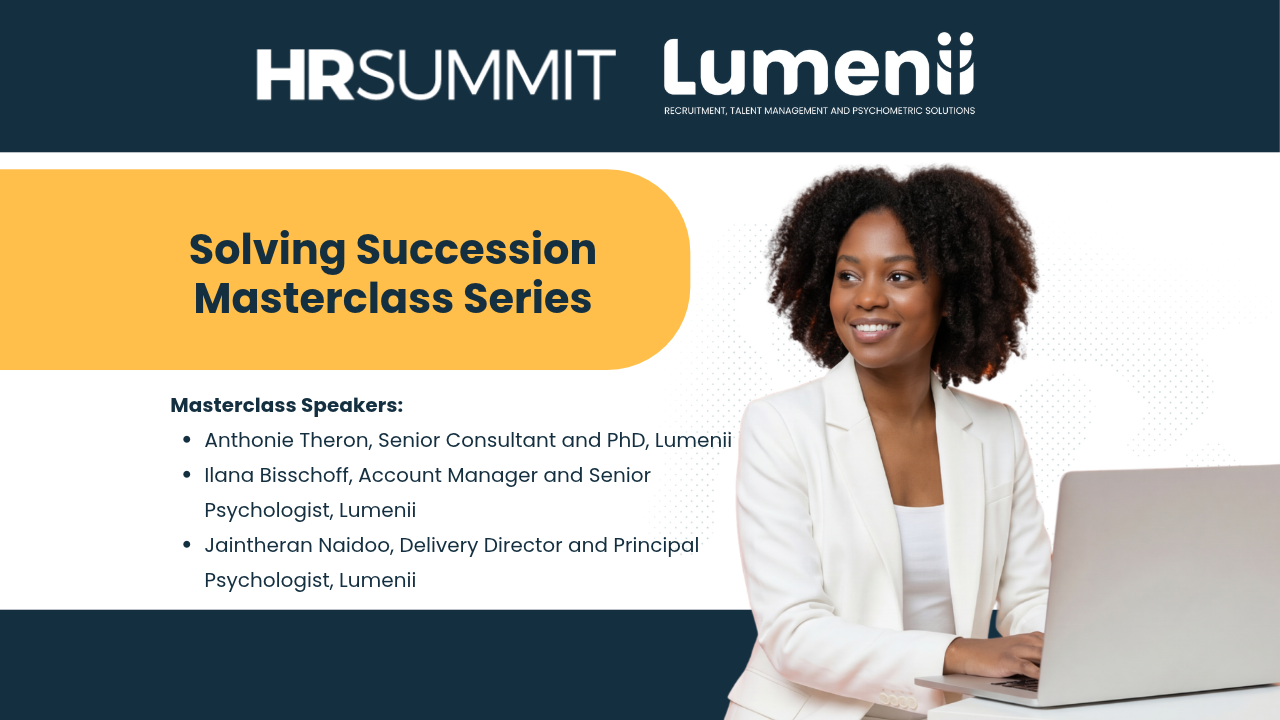
Three Lumenii psychologists took centre stage for HR Summit 2026’s Succession Planning masterclass series on 2 September 2026 at the Sandton Convention Centre. HR leaders, directors, executives and hiring managers filled the room for all four sessions.
The sessions moved through the full arc of where succession planning breaks down: how AI and talent mobility are reshaping the pipeline, why the 9-box grid can quietly steer decisions off course, what happens to talent once it’s been identified but never developed, and how organisations shift from fearing succession planning to building a culture around it.
The workforce succession planning was built for doesn’t exist anymore
Lumenii’s Senior Consultant and PhD- Anthonie Theron opened the day by pulling apart an assumption most succession frameworks are still quietly built on- that people stay in a role long enough to be groomed for the next one. That assumption is the first casualty of a workforce that moves sideways, in and out of projects, and across functions faster than any org chart gets updated.
AI isn’t replacing succession planning. It’s exposing how slow succession planning has become. What counts as “ready for the role” is moving faster than most plans on file can track.
Skill requirements shift within a single planning cycle. Career paths that once ran predictably up a ladder now move sideways through stretch projects and short-term assignments that never make it onto a traditional succession chart. Plans built around a fixed job title can often get out of date before they’re even signed off.
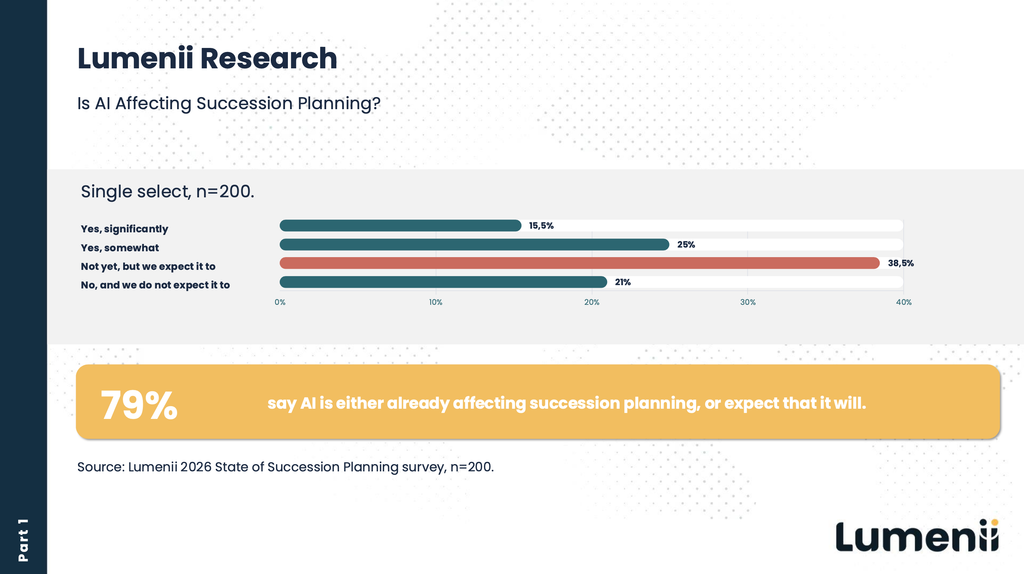
Lumenii’s own data backs the scale of the shift. The 2026 State of Succession Planning survey found that 79% of respondents say AI is either already affecting succession planning in their organisation or expect it to soon (Lumenii, 2026, n=200). Only 21% see no change coming at all.
Skill signals someone’s ready. Agility signals whether they’ll still be ready once the role changes. It usually comes down to five things: how fast someone reads a new situation, how they adjust to people, how they handle a shifting plan, whether results hold up through all of it and how clearly, they see their own strengths and blind spots.
Your 9-box grid might be telling you the wrong story
The second masterclass took the tool most HR teams already use for succession decisions and asked whether it deserves the trust it gets. The 9-box grid plots people against performance and potential, and the box someone lands in often decides whether they make the succession pool at all.
Performance is the first weak point. It’s a rating built for reward decisions, based on how someone did in the job they’re already in. Reused for succession, it answers a different question than the one being asked.
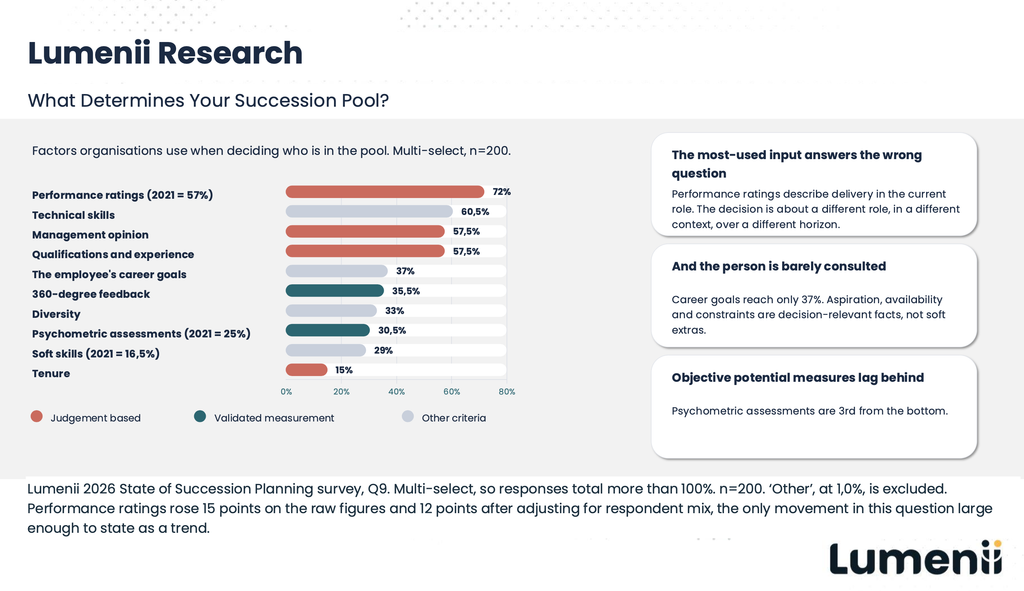
Potential is the harder one. Lumenii’s 2026 State of Succession Planning survey found management opinion still decides potential in 57.5% of organisations, against a validated instrument in just 30.5%. Performance ratings top the list of what determines the succession pool at 72%, up from 57% in 2021, while psychometric assessments sit third from the bottom and career goals factor in for only 37% of organisations.
The session’s counter was five checkable inputs in place of one manager’s impression: cognitive assessment, Learning Agility, personality fit against the role’s actual demands, motivational fit, and structured behavioural evidence gathered the same way for every candidate.
Naming a successor is not the same as building one
In the later session we picked up where identification usually stops – what happens once someone is actually named as a successor.
Development plans usually get built around one thing at a time. The gap an assessment surfaced, the business’s need for a specific capability, or the person’s own ambition, instead of all three together. Miss the person’s ambition and the plan feels done to them, not with them, and disengagement follows. Miss the business need and the organisation develops a capability it never calls on. Miss the actual succession gap and it’s just a generic leadership programme that doesn’t move anyone closer to a specific role. The only plan worth writing sits where all three overlap.
Finding that overlap depends on knowing what’s actually missing, which is why Anthonie Theron worked through a toolkit for it: psychometric assessment measured against the target role rather than the current one, 360-degree feedback, a skills audit at the level of a specific capability, structured behavioural evidence, performance metrics, and a qualitative talent review debate.
What these tools tend to expose is a hierarchy of development difficulty- intrapersonal capability such as self-awareness and resilience is hardest to shift, interpersonal skill next, leadership capability easier still, and business or technical skill easiest of all (Hogan & Warrenfeltz, 2003; Lacerenza et al., 2017).
Most succession plans die from avoidance, not bad design
The final session named what most succession conversations avoid saying out loud: HR is scared of the grey areas in succession. 85% of leaders see strategic succession planning as critical, yet only 23% are actually implementing a plan.
Lumenii’s own data shows the same gap – 90% call succession planning a high priority, but only 31.5% have a structured approach across the organisation
Ownership doesn’t help: leadership, the CEO and the board all rate it as mattering most to them, while HR and the individual trail behind. It’s claimed everywhere at the top, carried by nobody, so it lands on HR by default.
The masterclass named several ways this quietly fails.
- HR owns it alone, and HR ends up the only one still worrying once leadership’s attention moves on.
- A successor is named with no development action attached, and that name goes nowhere.
- Plans get built around the role as it exists today, not what the organisation needs in three years.
- Performance stands in for potential, fast-tracking the wrong people.
- And without a plan for a top performer being offered a role elsewhere internally, the organisation can lose them anyway.
The fix as the session framed it, is the shift from succession planning to a succession culture: from an annual, HR-owned meeting run in secret off a spreadsheet, to an ongoing, business-owned conversation that develops capability before a vacancy exists.
Getting there takes six questions in sequence; where are we vulnerable, what will roles require in future, what talent do we have, what’s the gap, how do we close it, and do we review it repeatedly. Skip the review, and the rest just repeats the annual-meeting problem in a new format.
Four rooms, one thread
None of this needs a total rebuild. It needs plans that get revisited, 9-box grids fed with real evidence instead of opinion, and successors who get an actual next step instead of just a name on a list. The room stayed full for all four sessions, which says HR is ready to do exactly that. Lumenii brought the research. The rest is a handful of decisions your team can start making this week.
Where to start
Download: SANBS Casestudy | Health System Trust Casestudy
See our succession software in action: https://lumenii.zohobookings.com/#/jason
Reference
Lumenii’s 2026 State of Succession Planning survey (Lumenii, 2026, n=200)
Lumenii’s 2021 State of Succession Planning survey (Lumenii, 2021, n=200)